
In Colorado, house arrest is an alternative sentencing option to a jail sentence or prison term. In many cases, you have to wear an electronic monitoring ankle bracelet as a condition.
The primary benefit of house arrest (also called “home detention”) is that you can serve your sentence within your home or approved residence while also
- maintaining your employment and
- reintegrating into the community.
The following graphic shows some of the activities courts commonly approve for defendants serving house arrest.
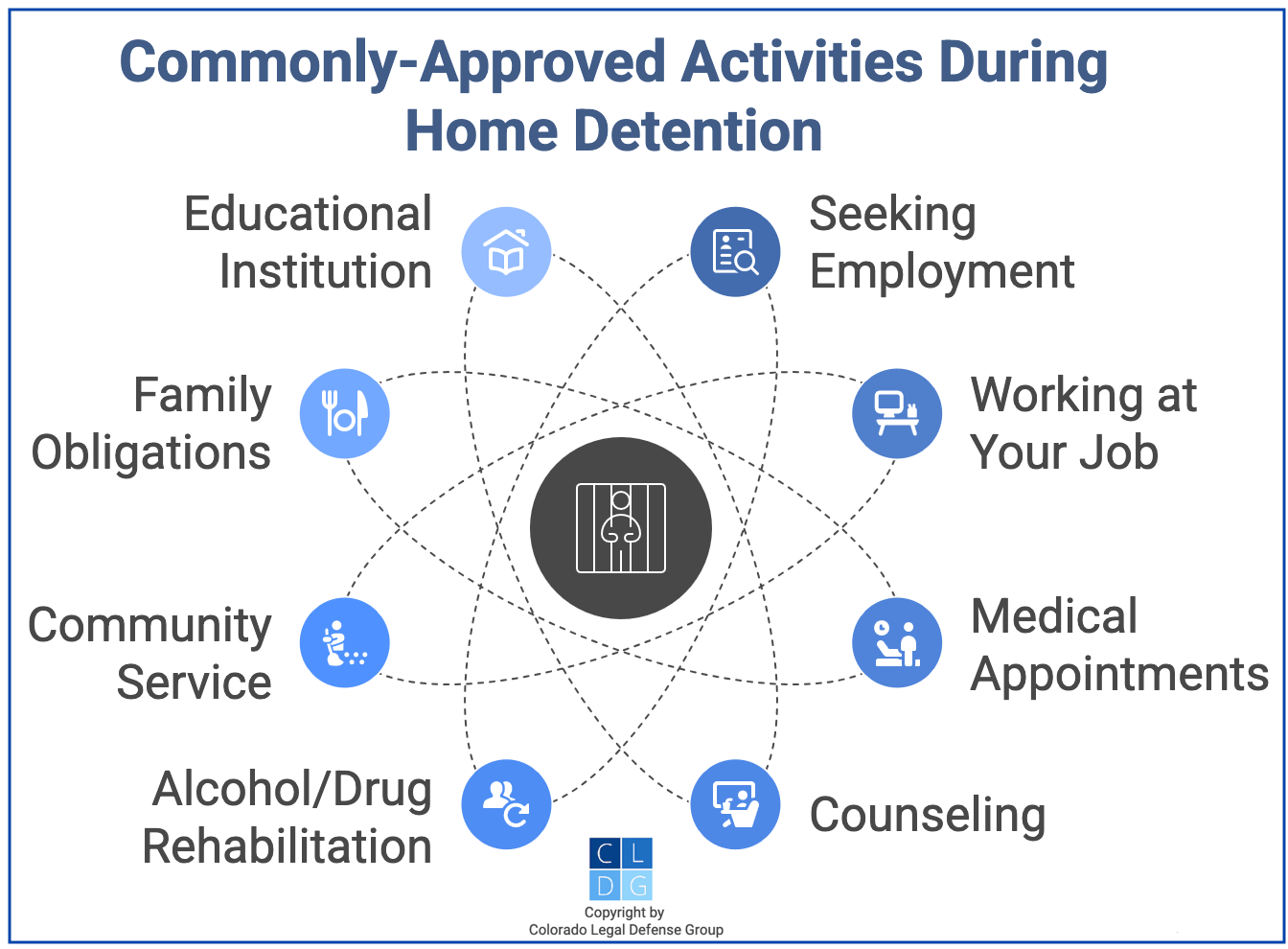
In this article, our Denver criminal defense lawyers will address the following key issues regarding home detention in Colorado:
1. Eligibility
Not everyone convicted of a Colorado crime is eligible for home detention, even with an otherwise clean criminal history.1
You may petition the court during the sentencing hearing or later for approval to participate in a home detention program. The court can also withdraw the home detention privilege at any time, with or without notice.2
Colorado house arrest may be available if you are convicted of
- a misdemeanor,
- a felony,
- nonpayment of any fine, or
- contempt of court
if the court deems such a sentence appropriate for you and would be otherwise eligible for probation. Though manage your expectations: Many people who request home detention do not get it.3
Note that if you are convicted of a sex crime, crime related to domestic violence, or class 1 misdemeanor involving the use of a deadly weapon, you are not eligible for home detention programs.4

House arrest is an alternative to jail where you can serve your sentence at home.
2. Electronic Monitoring
House arrest in Colorado is monitored by electronic devices that detect and report your absence or presence within the approved residence. If electronic monitors detect that you are not in the residence as required by the terms of your release, the violation will be reported.
Violations of the terms of house arrest may result in
- revoking home detention,
- additional penalties, or
- imprisonment.
Aside from electronic devices, the terms of probation or home detention may permit a law enforcement officer, parole officer or probation officer to show up at any time and conduct a search or drug test (usually urinalysis).
What Home Monitoring Costs
The costs of home monitoring depend on whether you are gainfully employed, your other costs, and the type of monitoring involved.
If you are gainfully employed, your wages are distributed by the sheriff to pay for:
- child support,
- fines and restitution,
- spousal maintenance,
- victim compensation, and
- administrative services.
Note that courts cannot deny you home monitoring solely because you cannot afford it.
Types of Electronic Monitoring
There are different types of electronic monitoring systems, and each county has its own procedures.
Basic electronic monitoring involves you wearing an ankle transmitter and plugging a monitoring unit into a power outlet in your home. (You also need either a landline or cellular service for the unit to work.) Your anklet then transmits a 24-hour radio frequency (RF) signal to the monitoring agency, which checks for “irregularities” such as:
- tampering with the anklet or monitoring unit,
- staying out past curfew, and
- going to locations that are prohibited under your house arrest agreement.
The majority of Colorado counties use ankle monitors with advanced GPS (global positioning system) technology. It relies on commercial cellular networks to map, track, and send data about your whereabouts 24/7 to the monitoring agency. Therefore, the agency always knows when you are in an “inclusion zone” or have ventured into an “exclusion zone.”
Alcohol and Drug Monitoring
If you are on house arrest for DUI or other alcohol-related crime – or if you are an alcoholic – the judge may order that you wear a Secure Continuous Remote Alcohol Monitor (SCRAM) anklet as well. This device uses transdermal testing to check whether you have ingested any alcohol.
Similarly, if you are on house arrest for a drug-related crime or are an addict, the judge may order you to wear a drug patch that picks up traces of narcotics you may have ingested. Drug patches get checked and replaced once a week.
SCRAM devices do not monitor your location.

House arrest is a privilege, not a right.
3. Violations
Violating the terms of home detention may result in your house arrest in Colorado being revoked. Common violations include:
- not being at home during required hours
- not showing up to work, school, or face-to-face meetings with your probation officer,
- failing a drug test,
- breaking curfew,
- alcohol detection on the continuous alcohol monitoring device, or
- failure to pay restitution or fines.
If the monitoring devices detect that you are not at home during required hours, your probation or parole officer will be notified, and a warrant may be issued for your arrest.
You are then entitled to a hearing where you can argue to the judge that you did not violate the terms and should be allowed to remain on house arrest. If the court finds that you did violate probation, the court may:
- reprimand you,
- harshen and extend your probationary period, or
- remand you to prison.

Many people placed on house arrest are placed on electronic monitoring.
Frequently Asked Questions
Who is eligible for house arrest in Colorado?
You may be eligible for house arrest if you are convicted of a misdemeanor, felony, nonpayment of fines, or contempt of court, and the court deems you appropriate for probation. However, you are not eligible if convicted of sex crimes, domestic violence-related crimes, or class 1 misdemeanors involving deadly weapons. Many people who request house arrest don’t get it, as it’s a privilege, not a right.
How much does house arrest cost and who pays for it?
The cost depends on your employment status and type of monitoring. If you are employed, your wages are distributed by the sheriff to pay for child support, fines, restitution, and administrative services first. Courts cannot deny house arrest solely because you can’t afford it. You may also be responsible for supervision and administrative costs.
What happens if I violate the terms of my house arrest?
Common violations include missing curfew, failing drug tests, not showing up to work or meetings, or alcohol detection. If you violate terms, your house arrest may be revoked and a warrant issued for your arrest. You’re entitled to a hearing where you can defend yourself. If found guilty, the court may reprimand you, extend your probation, or send you to prison.
What types of monitoring devices will I have to wear during house arrest?
Most people wear ankle monitors with GPS technology that track your location 24/7. Basic systems use radio frequency signals, while advanced GPS systems use cellular networks. For alcohol-related crimes, you may also wear a SCRAM device that tests for alcohol through your skin. Drug-related crimes may require a drug patch that’s checked weekly.
Additional Reading
For more in-depth information, refer to these scholarly articles:
- Home as Prison: The Use of House Arrest – Federal Probation.
- Between the ‘Home’ and ‘Institutional’ Worlds: Tensions and Contradictions in the Practice of House Arrest – Critical Criminology.
- House Arrest: A Critical Analysis of an Intermediate-Level Penal Sanction – University of Pennsylvania Law Review.
- A Brief History of House Arrest and Electronic Monitoring – Northern Kentucky Law Review.
- Exploring the Option of House Arrest – Federal Probation.
Legal References
- C.R.S. 18-1.3-106 – County jail sentencing alternatives – work, educational, and medical release – home detention – day reporting – definition.
(1)
(a) Any county may provide a program whereby any person sentenced to the county jail upon conviction for a crime, nonpayment of any fine or forfeiture, or contempt of court may be granted by the court the privilege of leaving the jail during necessary and reasonable hours for any of the following purposes:
(I) Seeking employment;
(II) Working at his or her employment;
(III) Working at a self-employed job or occupation, when properly verified;
(III.5) Working to provide child or family care services that are reasonable and necessary to support the immediate needs of the family, when properly verified;
(IV) Attendance at an educational institution;
(V) Medical treatment;
(VI) Home detention;
(VII) Day reporting;
(VIII) Behavioral health treatment; or
(IX) Reentry program.
(b) A court may order a person who would otherwise be sentenced to the county jail upon conviction of a crime to be sentenced directly to an available day reporting program, residential behavioral health treatment program, or residential reentry program if the court deems such a sentence to be appropriate for the offender.
(1.1) For purposes of this section, “home detention” means an alternative correctional sentence or term of legal supervision wherein a defendant charged or convicted of a misdemeanor, felony, nonpayment of any fine, or contempt of court is allowed to serve his or her sentence or term of supervision, or a portion thereof, within his or her home or other approved residence. Such sentence or term of supervision shall cause the defendant to remain within such defendant’s approved residence at all times except for approved employment, court-ordered activities, and medical needs. Supervision of the defendant shall include personal monitoring by an agent or designee of the referring unit of government and monitoring by electronic or global positioning devices that are capable of detecting and reporting the defendant’s absence or presence within the approved residence.
(1.3) Before a court may grant a person sentenced to the county jail the privilege of leaving the jail to attend a postsecondary educational institution, the court shall first notify the prosecuting attorney and the postsecondary educational institution of its intention to grant the privilege and request their comments thereon. The notice shall include all relevant information pertaining to the person and the crime for which he or she was convicted. Both the prosecuting attorney and the postsecondary institution shall reply to the court in writing within fourteen days after receipt of the notification or within such other reasonable time in excess of fourteen days as specified by the court. The postsecondary educational institution’s reply shall include a statement of whether or not it will accept the person as a student. Acceptance by a state postsecondary educational institution shall be pursuant to section 23-5-106, C.R.S.
(2) Unless directly sentenced to a day reporting program, residential behavioral health treatment program, or residential reentry program, pursuant to subsection (1)(b) of this section or unless such privilege is otherwise expressly granted by the sentencing court, the prisoner shall be confined as sentenced. The prisoner may petition the court for such privilege at the time of sentencing or thereafter and, in the discretion of the court, may renew his or her petition. The court may withdraw the privilege at any time by order entered with or without notice.
(3) The sheriff or the director of an alternative sentencing program may endeavor to secure employment for unemployed prisoners under this section. If a prisoner is employed for wages or salary, the sheriff may collect the same or require the prisoner to turn over his or her wages or salary in full when received, and the sheriff shall deposit the same in a trust checking account and shall keep a ledger showing the status of the account of each prisoner.
(4) Every prisoner gainfully employed may be liable for the cost of his or her board in the jail or the cost of the supervision and administrative services if he or she is home-detained, as fixed by the board of county commissioners. If necessarily absent from jail at mealtime, he or she may, at his or her request, be furnished with an adequate nourishing lunch to carry to work. The sheriff or the director of the alternative sentencing program, as may be applicable, may charge his or her account, if he or she has one, for such board. If the prisoner is gainfully self-employed, he or she may pay the sheriff or the director of the alternative sentencing program for such board, in default of which his or her privilege under this section is automatically forfeited. If the jail food is furnished directly by the county, the sheriff or the director of the alternative sentencing program may account for and pay over such board payments to the county treasurer. The board of county commissioners may, by resolution, provide that the county furnish or pay for the transportation of prisoners employed under this section to and from the place of employment. The sheriff or the director of the alternative sentencing program shall reimburse the county or other disbursing agent for all such expenses incurred in accordance with this section and article 26 of title 17 as soon as adequate funds are available in the prisoner’s account and in accordance with subsection (5)(b) of this section.
(5) By order of the court, the wages or salaries of employed prisoners shall be disbursed by the sheriff for the following purposes, in the order stated:
(a) Payment of any current child support order;
(b) Payment of any child support arrearage;
(b.3) Payment of any child support debt order;
(c) Payment of any spousal maintenance;
(d) Payment of costs for the crime victim compensation fund, pursuant to section 24-4.1-119, C.R.S.;
(e) Payment of surcharges for the victims and witnesses assistance and law enforcement fund, pursuant to section 24-4.2-104, C.R.S.;
(f) Payment of restitution;
(g) Payment of a time payment fee;
(h) Payment of late fees;
(i) Payment of any other fines, fees, or surcharges;
(j) Payment of the board of the prisoner;
(k) Payment of the supervision and administrative services provided to the prisoner during his or her home detention;
(l) Payment of necessary travel expense to and from work and other incidental expenses of the prisoner;
(m) Payment, either in full or ratably, of the prisoner’s obligations acknowledged by him or her in writing or which have been reduced to judgment; and
(n) The balance, if any, to the prisoner upon his or her discharge.
(6) The court may by order authorize the sheriff to whom the prisoner is committed to arrange with another sheriff for the employment or home detention of the prisoner in the other’s county and, while so employed or so detained, for the prisoner to be in the other’s custody but in other respects to be and continue subject to the commitment.
(7) If the prisoner was convicted in a court in another county, the court of record having criminal jurisdiction may, at the request or with the concurrence of the committing court, make all determinations and orders under this section which might otherwise be made by the sentencing court after the prisoner is received at the jail.
(8) The board of county commissioners may, by resolution, direct that functions of the sheriff pursuant to either subsection (3) or (5) of this section, or both, be performed by the county department of human or social services; or, if the board of county commissioners has not so directed, a court of record may order that the prisoner’s earnings be collected and disbursed by the clerk of the court. Such order must remain in force until rescinded by the board or the court, whichever made it.
(9) The county department of human or social services shall, at the request of the court, investigate and report to the court the amount necessary for the support of the prisoner’s dependents.
(10) The sheriff may refuse to permit the prisoner to exercise his or her privilege to leave the jail as provided in subsection (1) of this section for any breach of discipline or other violation of jail regulations. Any such breach of discipline or other violation of jail regulations shall be reported to the sentencing court.
(11) A prisoner who has been convicted of one of the crimes of violence as defined in section 18-1.3-406 (2), who has been convicted of a sex offense as defined in sections 18-1.3-903 (5) and 18-3-411, who has been convicted of a crime, the underlying factual basis of which was found by the court to include an act of domestic violence, as defined in section 18-6-800.3 (1), or who has been convicted of a class 1 misdemeanor in which a deadly weapon is used shall not be eligible for home detention pursuant to this section.
(12) Repealed.See, for example, In Re Gunkel (Colo. 2021) No. 20SA409; Caswell v. People (Colo. 2023) 536 P.3d 323. - C.R.S. 18-1.3-106.
- C.R.S. 18-1.3-106(1)(b).
- C.R.S. 18-1.3-106(11).