

Colorado Revised Statute § 18-8-112 C.R.S. prohibits impersonating a peace officer by falsely pretending to be a police officer and performing an act while pretending that role.
As a class 5 felony, impersonation of a peace officer carries
- one to three years in prison (plus two years of parole) and/or
- a fine of $1,000 to $100,000.
Depending on the case, it may be possible to get probation instead of prison.
In this article, our Denver criminal defense lawyers will address the following key issues regarding impersonation of a peace officer in Colorado law:
- 1. Elements of C.R.S. 18-8-112
- 2. Examples
- 3. Additional Charges
- 4. Defenses
- 5. Related Offenses
- Frequently Asked Questions
- Additional Reading
1. Elements of C.R.S. 18-8-112
For you to be convicted of impersonating a peace officer in Colorado, prosecutors have the burden to prove beyond a reasonable doubt the following two elements of the crime:
- You falsely pretended to be a policeman or policewoman, and
- You performed an act while pretending that role.1
“Impersonation” means to:
- act like,
- pretend to be,
- represent that you are, or
- create the belief in another that you are
a peace officer when you are not. Meanwhile, a “peace officer” is either:
- a policeman or policewoman in uniform, or
- if out of uniform, one who has identified themself by exhibiting their credentials as a peace officer.2
Therefore, you can be charged with impersonating a peace officer even if you are not dressed up as one. You just have to identify yourself as one.

C.R.S. 18-8-112 is the Colorado code section that makes it an offense to impersonate a peace officer.
2. Examples
Common acts of impersonation of a peace officer include (but are not limited to):
- dressing as a police officer while directing foot traffic at a protest;
- presenting fake police credentials, such as a police badge;
- pulling over a driver with red and blue lights;
- directing road traffic while indicating yourself as a peace officer;
- making an arrest; or
- verbally indicating to others that you are a police officer.
Note that you can still dress up as a policeman or policewoman for fun, like during Halloween. For it to rise to the level of impersonation under C.R.S. 18-8-112, you must do something that a real police officer would perform in their official capacity.
3. Additional Charges
Impersonating a peace officer is charged alongside other criminal conduct allegedly committed during the impersonation. Crimes which commonly occur alongside police impersonation include:
- Sexual assault/rape;
- Theft;
- Assault;
- Fraud; and
- Kidnapping.
Depending on the facts of the case, the penalties for these offenses, together with a C.R.S. 18-8-112 conviction, may be imposed consecutively (one after the other), thereby greatly increasing the overall prison sentence. We would argue for the penalties to run concurrently (at the same time).

Wearing police costumes that are clearly costumes is no crime.
4. Defenses
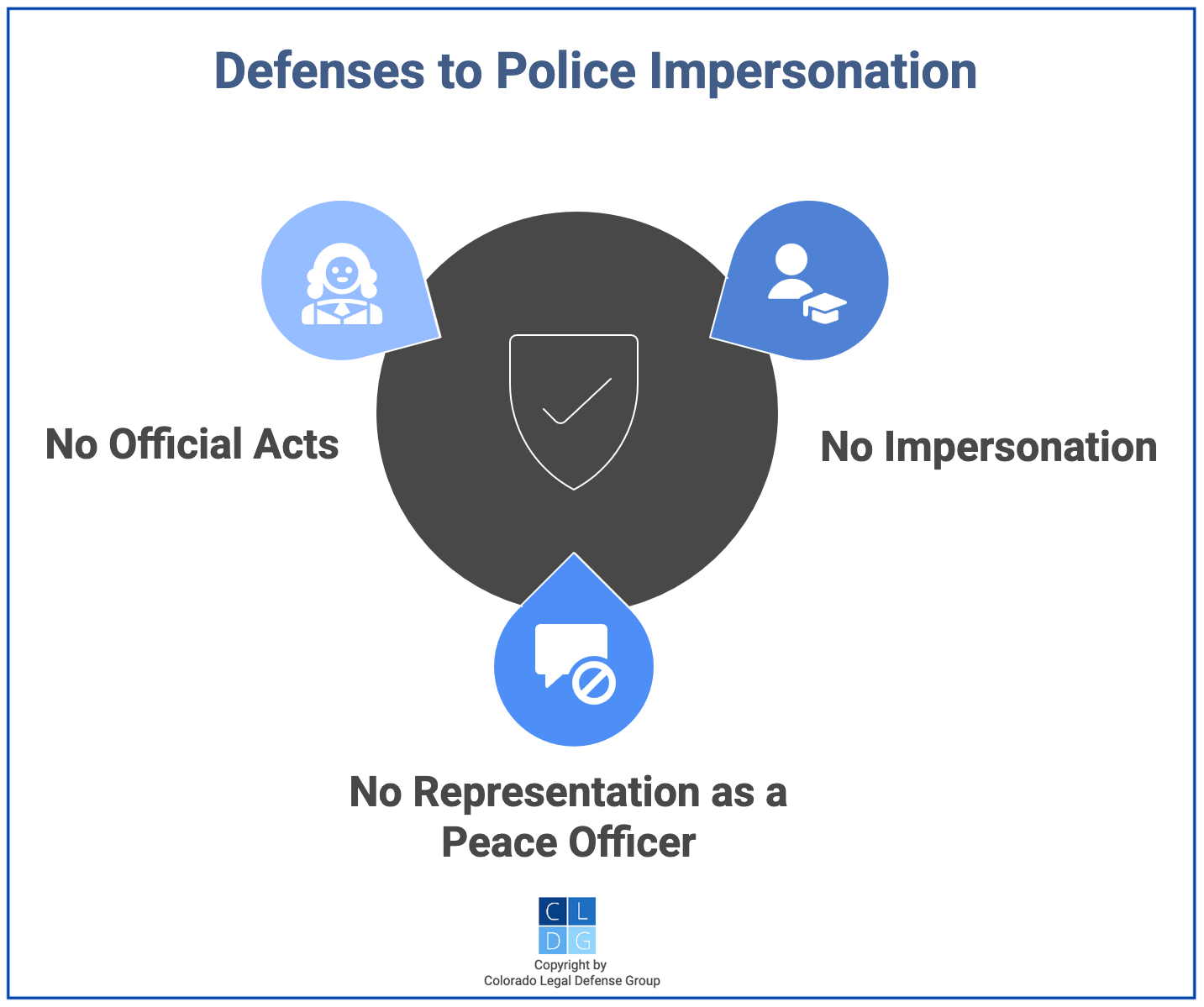
Here at Colorado Legal Defense Group, we have represented literally thousands of people charged with fraud crimes, including impersonation of a peace officer. In our experience, the following three defenses have proven very effective at getting C.R.S. 18-8-112 charges reduced or dismissed through a plea deal.
- You were not impersonating a peace officer;
- You did not represent to others that you were a policeman or policewoman; or
- You performed no official acts of a peace officer.
Note that it is not a defense that you meant no harm, that no one ended up getting hurt, or that you did good deeds while impersonating the police, such as quelling a riot or shielding a victim.
Typical evidence in these cases includes video surveillance footage and eyewitness accounts.
5. Related Offenses
- Obstructing a Peace Officer – using (or threatening to use) force to obstruct, impair, or hinder a police officer, firefighter, emergency medical services provider, rescue specialist, or volunteer.3
- Disarming a Peace Officer – knowingly removing a firearm, stun gun, or other similar device from a peace officer while under color of their official authority.4
- Impersonating a Public Servant – falsely pretending to be a public servant (other than a peace officer) and then performing any act in the pretended capacity.5

Impersonation of a police officer is a Colorado felony.
Frequently Asked Questions
Can I get in trouble for wearing a police costume on Halloween or for a party?
No, you can lawfully wear a police costume for fun or entertainment. To be charged with impersonating a peace officer, you must actually pretend to be a real police officer and perform official acts that real officers do, like making arrests or pulling over drivers.
What exactly counts as “impersonating” a peace officer under Colorado law?
Impersonating means acting like, pretending to be, or making others believe you are a police officer when you’re not. You do not have to wear a uniform – simply telling people you are a cop and then doing something a real officer would do (like directing traffic or showing fake badges) can be enough.
What is “Lacy’s Law” in Colorado?
C.R.S. 18-8-112 is often referred to as “Lacy’s Law.” It was named in honor of Lacy Miller, a college student who was tragically abducted and murdered in 2003 by an individual using fake police lights to stage a traffic stop. Following this event, the Colorado Legislature significantly increased the penalties for police impersonation, elevating it from a misdemeanor to a high-level felony to deter “blue light” predators.
Is it against the law to possess red and blue police lights?
Yes. Under Colorado law (C.R.S. 42-4-238), the unauthorized possession or use of red or blue flashing lights is a standalone class 1 misdemeanor. You do not necessarily have to pull someone over to be charged; simply having the equipment installed or visible in a non-law enforcement vehicle can lead to criminal charges and the seizure of the equipment.
Why was this crime upgraded from a misdemeanor to a felony?
Historically, impersonating a peace officer was a misdemeanor. However, due to the high risk of public harm and the potential for impersonators to commit more violent crimes (such as kidnapping or assault), the state progressively upgraded the offense. It moved first to a class 6 felony and is currently classified as a class 5 felony, reflecting the state’s “zero tolerance” policy for those who undermine public trust in law enforcement.
Can I be charged if I only “verbally” claimed to be a cop?
Yes, provided you performed an act in that capacity. While many cases involve fake uniforms or lights, the statute applies if you “falsely pretend” by any means. If you verbally identify yourself as a detective or officer to gain entry to a building, obtain information, or command someone to stay put, you have “performed an act” that satisfies the requirements for a felony charge.
Additional Reading
For recent news articles regarding impersonation of police in Colorado, refer to the following:
- MSPD warns community of impersonation scams (Colorado Springs) – Fox21 News.
- Alleged police impersonator captured in Northern Colorado – CBS News.
- Denver police warn of law enforcement impersonator driving gray van – Fox31 News.
- 63-year-old man arrested on suspicion of impersonating an officer (Larimer County) – NBC9 News.
- Colorado man arrested, accused of impersonating a police officer to avoid I-25 traffic – CBS News.
Legal References:
- C.R.S. § 18-8-112 – Impersonating a peace officer. The full text of the statute reads:
(1) A person who falsely pretends to be a peace officer and performs an act in that pretended capacity commits impersonating a peace officer.
(2) Impersonating a peace officer is a class 5 felony.HB 23-1293. See also, People v. Burkard (Colo.App. 2025) 22CA1680 (unpublished) (Texting the victim with specific instructions or assertions – like claiming a statement was already recorded – constituted “performing an act” in that pretended capacity). - See also C.R.S. § 18-8-116(3).
- C.R.S. § 18-8-104. Obstructing a Peace Officer.
- C.R.S. § 18-8-116. Disarming a Peace Officer.
- C.R.S. § 18-8-113. Impersonating a Public Servant.