
Colorado judges may revoke bond for bail violations such as for failing to appear (FTA) in court. Once a bond is revoked, you may be remanded to jail pending the outcome of the criminal case. The bail money may then be forfeited to the court.
How Bail Bonds Work
In Colorado, most people arrested on criminal charges are eligible for bail. As long as you put up a certain amount of money (“bail” or “surety”) to the court, the judge will release you pending the resolution of the case.
You can remain out of custody as long as you follow all the bail conditions (such as showing up to court). Then when the case ends, the court returns (“exonerates”) the bail money.
Hiring a Bondsman
However, you may not have enough cash to afford the bail amount. Therefore, you can turn to a bail bondsman for help. Bondsmen put up the entire bail amount in exchange for a premium – usually 15% of the total surety bond.
The person or people who pay the bondsman are called “indemnitors.” As an indemnitor, you have to give the bondsman collateral such as deeds to real property, car title, or jewelry.
After the Case Ends
When the case ends, the court returns the entire bail amount to the bondsman. You, as an indemnitor, do not get your 15% back from the bondsman.
The bondsman has 14 calendar days after the bail is exonerated to return your collateral. Otherwise, they risk losing their license and face class 2 misdemeanor charges carrying up to 120 days in jail and/or a fine of up to $750.1
When Courts Revoke Bond
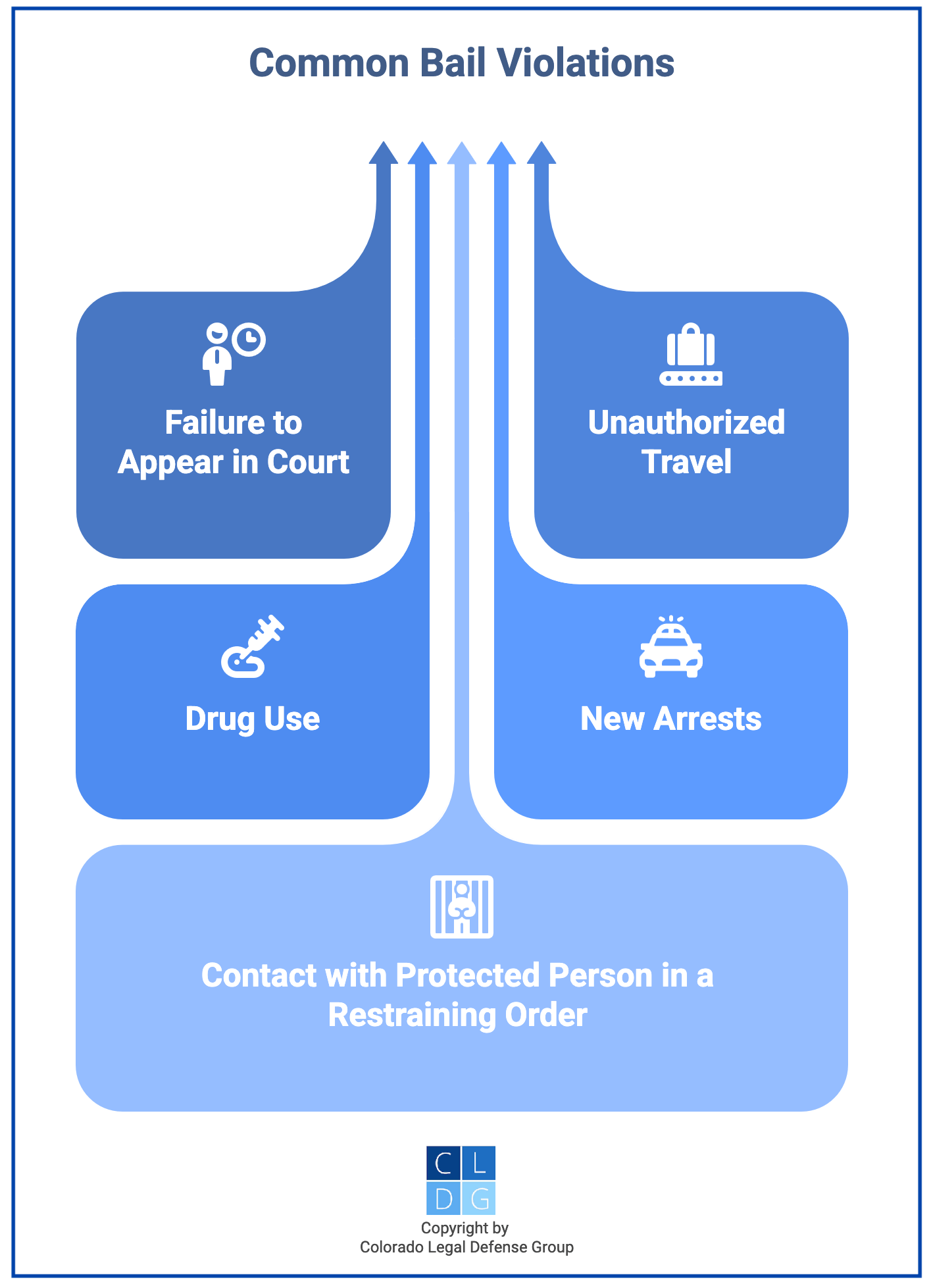
The main reason Colorado courts revoke bond is that you violate your bail conditions. One condition that all defendants out on bail are required to follow is showing up to future court appearances. Other common bail conditions include:
- Abstaining from drugs;
- Staying out of trouble (no more arrests);
- Avoiding contact with the victim (if any); and
- Staying in the state (unless you have permission otherwise).
If you violate any of these terms, the judge may revoke bond and issue a bench warrant for your arrest. You can then be remanded to jail, and the bail amount may be forfeited to the court.
If you deliberately fail to appear in your case (especially when victims or witnesses are present), you can also be prosecuted under C.R.S. 18-8-212 for violation of bail bond conditions.
Second Chances
In some cases, following a bail violation, judges decide not to revoke bond and instead give you a second chance by:
- Giving you a warning;
- Raising the bail amount;
- Keeping you on house arrest;
- Keeping you on electronic monitoring;
- Ordering periodic drug testing; and/or
- Imposing other bail conditions
Then if you commit no more violations, the bond money should be returned at the end of the case.2
Bond Money After Revocation
If a Colorado court revokes your bond, the court may keep your bail money.
If a bondsman put up the money, they can send a bounty hunter after you to apprehend you and bring you to court. Once you are back in custody, the court can exonerate the bond back to the bondsman.
Otherwise, the bondsman may keep the collateral that you and any cosigners put up to hire the bondsman.3
Therefore, anyone who hires a bondsman for someone else should be certain that they will not “jump bail” and will follow all the court’s conditions.
See our related article, Fugitive Recovery Agent Colorado – How Bounty Hunters Work.

Most defendants are eligible for bail release in Colorado.
Release without Bail
In some Colorado cases, judges can release you on your own personal recognizance (sometimes called O.R. release or P.R. bond). This typically happens in minor misdemeanor and petty offense cases if the court’s eligibility investigator determines you have sufficient stability and ties to the community.
As long as you show up to future court appearances and follow any other court conditions, you can remain out of custody while the criminal case is pending.4
When Courts Deny Bail
Everyone in Colorado is bailable except in specific cases where the court finds the proof is evident or presumption great, and — for most categories — that release would place the public in significant peril. Bail can be denied for:
- Capital offenses,
- First-degree murder,
- crimes of violence committed while on probation, parole, bail, or after qualifying prior felonies,
- POWPO offenses (pre-2022 versions),
- Specified sexual assault offenses involving very young victims, and
- When a person has been convicted of a crime of violence or POWPO and is appealing or awaiting sentencing.
Note that if your case is for capital or 1st-degree murder charges, you may request a hearing to challenge whether proof is evident or the presumption great.
Also note that if you were on parole and arrested for a violent or weapon-related offense, bail cannot be set for 72 hours.
Finally, note that if bail is denied, your trial must start within 91 days or else bail must be set (except in capital/1st-degree murder cases).5

It may be possible to get a bail forfeiture “set aside” through a remission motion.
Bail after Conviction
If you are found guilty in Colorado, the court may agree to let you stay out of custody until sentencing as long as your bondsman consents and the offense is bailable after conviction. Bail bondsmen usually agree, provided you are not a flight risk.6
Bail Remission
If a Colorado court revokes and forfeits your bond, it may be possible to get the forfeiture “set aside” by submitting a bail remission motion. You typically have only one year after the forfeiture judgment is entered to ask for remission, and the court considers such factors as whether:
- your bail violation was willful,
- your bail violation prejudiced the government, and
- the government incurred expenses to locate you.
The court has discretion to give back all, some, or none of the forfeited bail money.7
When Bondsmen Withdraw Bonds
It is rare, but bail bondsmen are allowed to withdraw your bond while your Colorado case is still pending. If they do, the court can incarcerate you unless you can post bail yourself or through another bondsman.8

Defendants released on PR bond pay no bail.
Additional Resources
If you cannot afford bail or a bondsman, you may be able to secure bail money through these organizations:
- Colorado Freedom Fund – A nonprofit that pays bail for low-income people in Colorado.
- The Bail Project – A national organization providing free bail assistance and pretrial support.
- Immigrant Freedom Fund – A group that posts bond for immigrants detained by ICE.
- Community Justice Exchange – A network supporting community-based alternatives to incarceration.
Legal References
- C.R.S. 18-8-212. See also People v. Donald (2020) 461 P.3d 4. C.R.S. 18-13-130. Note that if you cannot post cash bail, you may be able to post a property bond directly with the court worth 1.5 times the bail amount. If your bond is revoked, the property goes to the court.
- Same.
- See C.R.S. 16-4-105 – 111. See also People v. Jones (2015) 346 P.3d 44.
- C.R.S. 16-4-104. See also C.R.S. 16-4-102 and C.R.S. 16-4-106.
- C.R.S. 16-4-101.
- C.R.S. 16-4-201. See also People v. Lewis (Colo. 2024) 555 P.3d 576.
- C.R.S. 16-4-114.
- C.R.S. 16-4-108.