
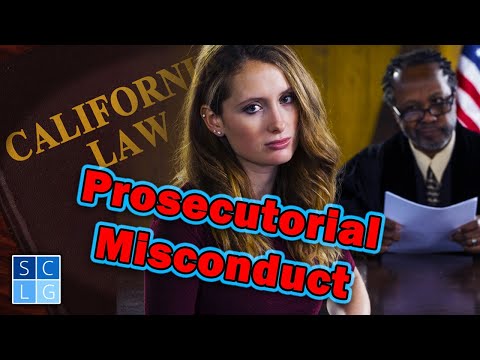
Prosecutorial misconduct refers to the unethical or illegal tactics by prosecutors in a criminal case, such as
- withholding exculpatory evidence from the defense,
- making false statements, or
- presenting inadmissible evidence to the jury.
When prosecutors are found to have committed misconduct, they can be disciplined and the defendant can be afforded relief. This can include a conviction being overturned.
When does this happen?
Prosecutorial misconduct is not limited to the context of a criminal trial. It can take place at any stage of the criminal court process. Some of these stages may include
What are the types of misconduct?
There are four main types of prosecutorial misconduct in the criminal justice system. These are:
- failing to disclose exculpatory evidence,
- introducing false evidence,
- using improper arguments, and
- discriminating in jury selection.
What are the remedies?
A judge can do any of the following if he/she finds that misconduct prejudiced the accused:
- dismiss the charge(s),
- admonish the jury to disregard certain evidence or comments, or
- grant a motion for a new trial
Note that malicious prosecution refers to something different than prosecutorial misconduct. The phrase refers to a case that gets filed without any legal foundation or basis for it. The case can be either civil or criminal in nature.
Note also that California law is consistent with the above rules and information. Penal Code 1181 is the California statute that says a judge may award a defendant with a new trial upon a finding of misconduct.
Our criminal defense attorneys will highlight the following in this article:
- 1. What are the four main types of prosecutorial misconduct?
- 2. What are the remedies for a defendant?
- 3. Is vindictive or malicious prosecution a form of misconduct?
- 4. Can the prosecutor be sued in civil court?
- 5. What is the law in California?
- Additional reading

Prosecutorial misconduct is when a prosecutor in a criminal court case performs an illegal or unethical act.
1. What are the four main types of prosecutorial misconduct?
There are four main types of prosecutorial misconduct. These are:
- failure to disclose exculpatory evidence,
- introducing false evidence,
- using improper arguments, and
- discriminating in jury selection.
1.1. Failure to disclose exculpatory evidence
Prosecutors have a legal duty to give the defense the following evidence:
- evidence suggesting that the accused is not guilty, and
- evidence suggesting that the accused deserves a lesser sentence.1
This evidence is often referred to as “Brady material.” The label comes from a real legal case Brady v. Maryland.
A prosecutor’s failure to turn over exculpatory evidence is a Brady violation and can lead to a finding of misconduct.
Example: Doug is charged with rape after a grand jury indictment. He has vehemently denied the charge since the first days he was investigated for it. In defense, he has always maintained that he was somewhere else when the crime was committed. He maintains he was at a going away party for an acquaintance. And there is no DNA evidence.
A problem with the defense is that Doug’s lawyer cannot find a solid alibi witness to testify to having seen Doug at the party.
A few weeks before trial, a person comes to the prosecutor’s office and gives a statement about the party. In it, she makes quick reference to seeing Doug there. The prosecutor buries this favorable evidence in the case file and does not share it with defense counsel. This is prosecutorial misconduct since the prosecutor withheld evidence in violation of the defendant’s rights.
A defendant can try to obtain this material by bringing a Brady motion.
1.2. Introducing false evidence
It is misconduct if a prosecutor introduces evidence that is false or inadmissible.2
Some of this evidence can include:
- hearsay statements,
- untrue or unfounded character evidence, and
- lies from a witness (or false testimony).
Example: A prosecutor is in the middle of a well-contested felony hit and run case. The only evidence he has left to try and secure a conviction is the testimony from a law enforcement officer. The officer is willing to testify that the criminal defendant admitted to him that he committed the crime.
The problem, however, is that the prosecutor knows that the officer is lying about the admission.
Bent on getting a guilty charge, the prosecutor has the police officer testify. The officer commits perjury and testifies that the defendant admitted that he committed the crime. The accused is later convicted in violation of the constitutional right to a fair trial.
Here, the prosecutor committed misconduct by introducing evidence that he knew was false to get a wrongful conviction. The defendant is entitled to a retrial.
1.3. Improper arguments
There are several types of arguments, or assertions, that a prosecutor cannot make during a criminal case.
For example, prosecutors cannot:
- assert or argue about facts not in evidence,
- comment on a defendant’s decision to not testify,
- express personal opinions about evidence or matters in a case, and
- give inflammatory comments.
It is considered misconduct if a prosecutor engages in any of the above. Note that this type of misconduct often occurs in either the prosecutor’s:
- opening argument, or
- closing argument.
1.3.1. Asserting facts not in evidence
In a criminal trial, both the prosecutor and defense counsel have to provide evidence for any facts they wish to assert.
It is misconduct, then, if the prosecutor refers to a fact for which there is no evidence.3
Example: Nia is on trial for a violent robbery. In her closing remarks at the trial, Ruth, the prosecutor, tells the jury that violent crime has declined significantly in the area where the robbery occurred since Nia has been locked up.
Ruth never introduced any evidence during the trial to support the statement that crime has declined in that area. Therefore, she has committed prosecutorial misconduct by arguing facts not in evidence in an effort to prove the defendant’s guilt beyond a reasonable doubt.
1.3.2. Commenting on the defendant’s failure to testify
A prosecutor can never comment on a defendant’s choice to not testify on his/her behalf.
The Fifth Amendment to the U.S. Constitution says that a defendant:
- does not have to testify against himself or herself, and
- does not have to do so in a criminal case.
It is misconduct, then, if:
- a defendant exercises his/her right not to testify, and
- the prosecutor comments about it.4
1.3.3. Expressing personal opinions
A prosecutor commits misconduct by:
- expressing his/her personal opinion, and
- doing so about some matter in a trial.5
Note, though, that not every opinion will result in misconduct.
For example, it is okay for a prosecutor to provide an opinion on the guilt of the accused. He/she can also give an opinion on the credibility of a witness. This is provided the opinion is based on actual evidence produced at trial.
The general rule is that a prosecutor can opine if the opinion has a basis in the evidence presented. But unfounded opinions may lead to a finding of misconduct.6
1.3.4. Inflammatory comments
Certain inflammatory comments from a prosecutor can lead to a misconduct finding. This is provided that the comments are:
- dramatic, and
- appeal to the passions of the jury.7
An example is when the district attorney argues for so-called “safe streets.” This is an appeal to jury’s general fear of crime, rather than the evidence that the defendant committed a crime.
Example: In a child molestation trial, in closing arguments, the prosecutor comments “None of your own children will be safe if you let a predator like this back on the street.”
1.4. Discrimination in jury selection
Prosecutors can never discriminate when selecting a jury.8
This means a prosecutor cannot exclude a potential juror from a case because of his/her:
- sex,
- religion,
- ethnicity, or
- some other similar trait.9
Doing this is not only misconduct, but the act(s) violate:
- the defendant’s Sixth Amendment right to a fair trial, and
- the juror’s rights under the Equal Protection Clause of the Fourteenth Amendment.
Example: Marcos is the prosecutor on a highly publicized and graphic murder case. The defendant is a prominent member of the neighborhood’s African American community. The victim was a white supremacist.
During jury selection, Marcos’s plan is to try and exclude every potential juror that is an African American. He believes members of this race will side with the accused and vote for an acquittal. He succeeds in excluding four witnesses. Each exclusion is made on the sole basis of the juror’s race.
Here, Marcos discriminated on the basis of race, and therefore, committed prosecutorial misconduct.

Fortunately, there are remedies for a defendant who is denied due process by the District Attorney’s Office or the Attorney General.
2. What are the remedies for a defendant?
There are several possible remedies in cases of prosecutorial misconduct. These include:
- the judge dismisses the charge(s) against the accused,
- the judge admonishes the jury to disregard certain evidence or comments, or
- the judge may grant the defendant a new trial.
As to the latter, a judge can only award this after defense counsel brings a motion for a new trial. This motion has to be filed before the defendant’s sentencing.
Note though that these remedies are not available unless:
- the misconduct prejudiced the defendant, and
- the defense counsel objected to the misconduct.
2.1. Prejudice
Prosecutorial misconduct will not result in a remedy unless it prejudiced the defendant.
This means that the misconduct must have materially affected the trial outcome. If misconduct took place, but it did not materially affect the case, then a remedy is not granted.10
Example: Anthony is on trial for committing certain lewd acts with a child. During trial, the prosecutor makes several improper arguments, including:
- referring to facts not into evidence,
- giving inflammatory comments, and
- expressing personal opinions.
Anthony’s lawyer objects after each bout of “misconduct.” The judge then instructs the jury to disregard the arguments. Anthony is later found guilty on all charges.
Here, the objection and resulting instruction work to minimize the prejudicial effects of the prosecutor’s arguments. Given the instructions to the jury, the arguments did not impact the outcome of the trial. Thus, the misconduct is not prejudicial, and the guilty verdict would be upheld.
Note too that misconduct will not be deemed prejudicial if:
- the evidence against the accused was so overwhelming, and
- the trial outcome would have been the same even without the misconduct.11
2.2. Objection to misconduct
In most cases, a defendant cannot challenge a finding of misconduct unless:
- the defense counsel objected to it, and
- he/she did when the misconduct occurred.12
The reasoning behind this rule is that:
- if defense counsel objected to the misconduct at the time it happened,
- the judge could have instructed the jury to disregard it.
This instruction would have
- prevented prejudice and
- removed the need for a new trial.
Note that if no timely objection was made by defense counsel, an accused can still try to get a new trial on grounds of ineffective assistance of counsel.
3. Is vindictive or malicious prosecution a form of misconduct?
“Malicious prosecution” is different from a type of prosecutorial misconduct.
The phrase refers to a case that gets filed without any legal foundation or basis for it. The case can be either civil or criminal in nature.
A prosecutor or plaintiff often brings these cases out of ill will or for unjust reasons. Some reasons may include:
- harassment,
- political gain, or
- protection for the real wrongdoer.
Malicious prosecution technically occurs when:
- a person files a frivolous claim against another,
- the lawsuit was filed not to win, but rather for some other purpose, and
- a person suffered damages as a result.
4. Can the prosecutor be sued in civil court?
A person may be able to sue a prosecutor in civil court for malicious prosecution if:
- the prosecutor filed a frivolous charge, and
- the accused suffered some type of damages.
Example: A prosecutor’s brother runs for political office and loses. The prosecutor believes a local business owner disrupted his brother’s campaign.
Rumors soon start to spread that the business owner beats his wife. The prosecutor jumps on the gossip and charges the man with domestic violence counts and spousal abuse. The prosecutor remains on the case and the State investigates the owner for several months. During this time, the owner sees a substantial drop in his business, and he incurs several thousands of dollars in legal fees. After finding zero evidence of violence or abuse, the State drops the charges.
Here, the owner can file a civil case against the prosecutor for malicious prosecution. If found guilty, the prosecutor would have to reimburse the man for his legal fees and the financial losses to his business.
In addition, the person can report the prosecutor’s misconduct to the state bar. Depending on the case, the prosecutor may lose his/her law license.
5. What is the law in California?
Like all states, California law forbids prosecutors from engaging in misconduct or failing to act within the bounds of ethics. Further, Penal Code 1181 is the California statute that says a judge may declare a mistrial and grant a new trial if a finding of misconduct. 13 14
This is provided, however, that:
- the misconduct prejudiced the outcome of the case (not “harmless error”), and
- the defense attorney objected to it at trial.15
Additional reading
For more in-depth information, refer to these scholarly articles:
- Prosecutorial Misconduct in the Digital Age – Albany Law Review.
- Prosecutor Misconduct and Good Faith Error: A Reanalysis of Two Studies in California and Texas – Texas State University dissertation.
- Prosecutorial Misconduct in Death Penalty Cases – California Western Law Review.
- Preventable Error: A Report on Prosecutorial Misconduct in California 1997–2009 – Northern California Innocence Project Publications.
- Retooling and Coordinating the Approach to Prosecutorial Misconduct – Rutgers University Law Review.
Legal References:
- Brady v. Maryland (the Supreme Court, 1963) 373 U.S. 83; see also Kyles v. Whitley, (1995) 514 U.S. 419, 435.
- Towery v. Schiro, 622 F.3d 1237 (2010); see also Mooney v. Holohan, (1935) 294 U.S. 103; see also Napue v. Illinois (1959) 360 U.S. 264.
- Pyle v. Kansas, 317 U.S. 213 (1942). See also Limone v. United States, 497 F. Supp. 2d 143 (2007).
- United States v. Robinson, 485 U.S. 25 (1988). See also United States v. Whitten, 610 F.3d 168 (2010).
- United States v. Delgado, 631 F.3d 685 (2011).
- Smith v. McQuiggin, 2011 U.S. Dist. Lexis 116971.
- Darden v. Wainwright, 477 U.S. 168 (1986). See also Greer v. Miller, 483 U.S. 756 (1987).
- Batson v. Kentucky, 476 U.S. 79 (1986).
- See same.
- United States v. Acosta, 924 F.3d 288 (2019).
- People v. Prysock (Court of Appeals, 1982) 127 Cal.App.3d 972.
- People v. Ochoa (1998) 79 Cal.Rptr.2d 408. See also Ryan v. State, 9 N.E.3d 663 (Ind. 2014).
- People v. Rodriguez, 26 Cal. App. 5th 890 (Appellate Court, 2018).
- California Penal Code 1181 PC.
- People v. Rodriguez, supra.