Explanation of California Probation & Probation Violation Hearings
Facing a probation violation? Our California criminal defense attorneys can help anywhere in the state. Contact us for help.
California law defines probation as a type of supervisory sentence that a judge may impose in lieu of -- or in addition to -- incarceration.1 Both misdemeanor and felony convictions are typically eligible for a probationary sentence. But there are some exceptions, which will be addressed below.
Think of probation this way...You plead guilty to a crime or are convicted by a jury. At sentencing, the judge says to you:
"I could put you in jail (for, let's say, up to one year). But instead, I'm willing to let you stay free if you agree to be on probation. I will give you a checklist of certain things you must do, and certain things you cannot do. If you follow these rules, your probation will expire in 3 years and the case will be over. But if you violate any of these rules, I can -- and probably will -- put you in jail for the whole year."
Though misdemeanor probation and felony probation are structured differently, they each have certain terms and conditions which are strictly enforced. The failure to complete or abide by any of the terms and conditions may result in a probation violation hearing.
In order to understand better how California probation is imposed and how to win a probation violation hearing (also referred to as a probation revocation hearing), our Los Angeles criminal defense attorneys2 will address the following:
(Click on a title to proceed directly to that section)
1. An Overview of California Probation Law
2. How Misdemeanor Probation Works in California
3. How Felony Probation Works in California
4. Probation Violation Hearings
If, after reading this article, you would like more information, we invite you to contact us at Shouse Law Group.
You may also find helpful information in our related articles on California DUI Probation, Arrest Warrants, Bench Warrants, Search Warrants, Parole, and California Expungement Law.
1. An Overview of California Probation Law
California Penal Code 1203 PC and its related sections regulate California probation law. Although Penal Code 1203 PC was originally enacted in 1872, the law didn’t actually address probation until 1903. At that time, the law bestowed upon a judge much of the discretionary powers that he/she still holds today in determining what type of probationary sentence to impose.3
In 1909, the California Legislature added in a section relating to expunging one’s conviction (which is addressed later in this article) if the individual successfully completed his/her probation sentence.4
A 1927 amendment increased the court’s power with respect to punishment. It authorized the judge to impose jail, fines, or both in connection with probation. It also included a section that, in the event of a probation violation, any time spent in jail would be credited towards the violation.5
Then in 1931, the Legislature excluded certain persons from receiving a probationary sentence. Those who were convicted of certain listed offenses (including burglary, rape, or kidnapping) would be ineligible from being placed on probation.6
As the years went on, a number of changes were made to the statute, some major, some minor. Today, probation very much rests in the hands of the judge, as he/she is given a great amount of discretion to determine if and how a probationary sentence should be imposed.
According to California courts, the purpose of probation is to rehabilitate rather than to punish.7 In reality, judges impose it with both goals in mind.
2. How Misdemeanor Probation Works in California
This is generally imposed when a person gets convicted of a misdemeanor crime. Misdemeanor probation (also sometimes called "summary probation") typically lasts from one to three years, although in some cases, it can last as long as five.
No "Probation Officer" with misdemeanor probation
When serving a misdemeanor probation sentence, you do not report to a probation officer. Probation officers are only assigned in felony probation sentences, discussed below under "Felony Probation").
Progress reports
With misdemeanor probation, instead of reporting to a probation officer, you are typically expected to appear in court for periodic "progress reports." At these progress reports, the judge will review your case to make sure you are completing all the conditions required of you.
As long as you continue to abide by the court’s requirements, you will successfully complete probation and it will expire. If, however, you violate probation, you face a probation violation hearing (discussed below under "Probation Violation Hearings").
Unlike California parole (which is granted after an individual is released from prison), probation is a part of the sentencing process. When imposed, misdemeanor probation allows you either to (1) remain out of jail, or (2) shorten the length of your jail sentence.
Probation reports generally not required in misdemeanor cases
California law only requires that the judge obtain a probation report before issuing a misdemeanor probation sentence if you were convicted of a California sex offense that requires registration as a sex offender.8 For any other misdemeanor, the decision whether to order a probation report or simply to impose the probationary sentence lies with the judge.9
Judges have discretion as to imposing conditions of probation
California Penal Code 1203 allows a judge to exercise quite a bit of discretion when imposing probation requirements.
As long as the requirements logically relate to the offense for which you were convicted, the judge can impose any conditions he/she sees fit.10 Of course, if the conditions seem too strict or burdensome, you are always free to reject the misdemeanor probation sentence and to serve a jail sentence instead.11
Some of the most commonly imposed misdemeanor probation requirements include (but are not limited to):
- a mandatory restitution fine,12
- a restraining order (if your offense involved California domestic violence13 or another act of violence),
- abstaining from alcohol and/or drug use and possible attendance in a drug or alcohol program such as AA or NA (if your offense was drug or alcohol related),
- not driving with any measureable amount of alcohol and not refusing to submit to a chemical DUI blood or breath test (if placed on California DUI probation),
- installation of an ignition interlock device14 or a SCRAM ankle bracelet15 (generally imposed in connection with a multiple offense DUI conviction)
- "search conditions" (a provision in which you agree to allow the police to search you person or property at any time with or without a California search warrant)
- individual or group therapy,
- community service or Cal-Trans roadside work, and
- an order not to violate any additional laws.
3. How Felony Probation Works in California
If you get convicted of a felony crime and get placed on probation, it will be felony probation (also sometimes called "formal probation"). This operates very similar to misdemeanor probation. It too may be imposed for up to five years. But there are two major differences.
Probation officers
The first difference is with respect to supervision. When the court places you on felony probation, you are assigned to a probation officer. Generally, you must report to the probation officer once a month, although the judge has the discretion to require a greater or lesser frequency. Failing to remain in contact with your probation officer can itself trigger a probation violation / revocation hearing.
The purpose of this supervision is to ensure that you remain in the state and that you are complying with all the terms and conditions imposed on you by the court. Your probation officer (otherwise known as a P.O.) may also
- verify your employment (assuming that one of your probation requirements is to seek and maintain employment), and
- administer drug tests.
On occasion, your probation officer may enter your home to verify that you don’t possess any illegal drugs or weapons (an event generally known as a "probation search").
State prison if you violate felony probation
The second major difference is that if you violate felony probation, the court can send you to California State Prison for up to the maximum term. Depending on the offense for which you were originally convicted, the maximum term is 18 months or longer. If you do get sentenced to state prison, you will get credit for any custody time you already served on the case (dating back to the original arrest).
Probation reports required in felony cases
Prior to placing you on felony probation, the judge must obtain a probation report.16 These are reports are prepared by the county probation department, based on a review of the alleged crime and the defendant's personal and criminal history. Often times, the investigating detective, any alleged victims, and the defendant him/herself will be interviewed.
Both
- hearsay (a type of evidence which is typically excluded from trial, it refers to information that is relayed through a second-hand source), and
- illegally obtained evidence (such as drugs that were obtained by the police during an illegal search and seizure)
are permissible in a probation report and may be considered by the judge for sentencing purposes.17
However, if any wrongfully obtained evidence was previously suppressed or excluded during a suppression motion hearing…and that suppression resulted in a dismissal of the criminal charge…it will not be admissible during a probation revocation hearing18 (discussed in detail, below).
But as Palm Springs criminal defense attorney Michael Scafiddi explains19, "It’s almost irrelevant what evidence is admissible because a good criminal defense lawyer will find a way to challenge any and all detrimental information contained in your probation report."
Probation not available for certain felony crimes
Certain felony convictions will render you ineligible from receiving a probation sentence. These include
- violent felonies under California Penal Code 667.5 PC, or
- serious felonies under California Penal Code 1192.7(c)
if you were on felony probation at the time you picked up the new felony offense.20
In addition, there are other felony offenses that will render you ineligible for probation unless the judge believes that placing you on probation will best serve the interests of justice. These include (but are not limited to):
- the commission of certain serious felonies if you unlawfully carried or used a deadly weapon at the time,
- offenses where you willfully inflicted great bodily injury ("GBI") or torture on another person, and
- California Penal Code 451 PC arson.21
If convicted of any of these offenses, the judge will evaluate (1) the facts of the case, and (2) your personal history in order to determine whether the "interests of justice" will be best served by placing you on probation.22
4. California Probation Violation Hearings
Even though California courts state that the primary purpose of probation is to rehabilitate, violations will be punished. Some of the most common misdemeanor and felony probation violations include (but are not limited to):
- failure to pay a fine or restitution "FTP"23,
- failure to appear for a court date "FTA",
- failure to comply with a court order,
- failure to report to your probation officer,
- committing a new crime, and
- not submitting to, or failing, a drug test (if submitting to drug testing was a probation requirement).
If you are suspected of any one of the above, you will likely face a probation violation hearing (otherwise known as a "PVH" or a probation revocation hearing). Depending on the circumstances, either
- an officer will arrest you and bring you before a judge (if, for example, the officer arrested you for another crime), or
- a judge will issue a California arrest warrant for your arrest (if, for example, you failed to report to your probation officer).
And on a similar note, if you fail to appear for your scheduled probation revocation hearing, the judge will issue a California bench warrant for your arrest.
∗Note also that once you have a warrant out for your arrest, it is advisable that you immediately try to clear it. Voluntarily appearing before the judge is almost always treated more favorably than being brought to court, in custody, by the police. That said, it is a good idea to consult with an experienced California criminal defense to prepare a solid defense before doing so.
Along these same lines, it is also advisable to try to complete as many of your probation requirements as possible before returning to court. The fact that, for example, you failed to attend your AA meetings shouldn’t prevent you from continuing to fulfill your other obligations.
Your lawyer may be able to help you reestablish contacts or reenroll you in a program, which is why you should contact him/her immediately upon a probation violation.
Probation revocation hearing rights
A California probation violation hearing operates much like a mini-trial. But instead of a jury, a judge presides over the hearing. The person accused of the probation violation enjoys certain due process rights. These include24:
- the right to be represented by an attorney25,
- the right to call witnesses, and to use the subpoena power of the court to compel witnesses to come to court and testify on your behalf,
- the right to cross-examine and confront witnesses (unless the judge finds that a witness isn’t necessary and admits hearsay evidence instead),
- the right to present any mitigating or extenuating circumstances that contributed to the alleged probation violation, and
- the right to testify on your own behalf.
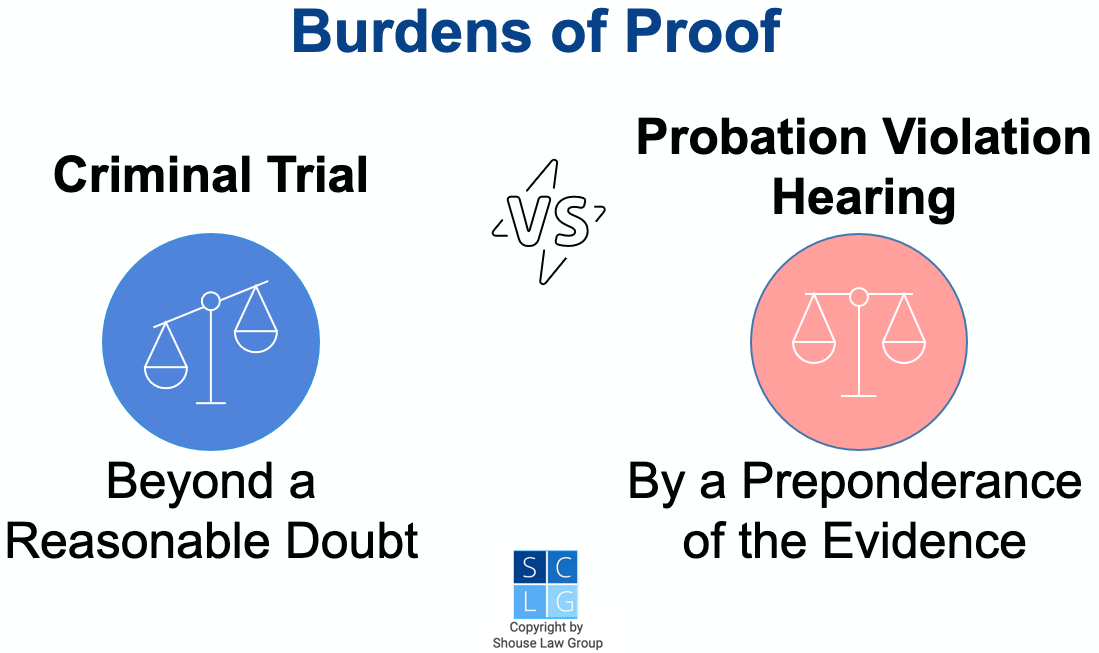
Unlike a criminal trial where the prosecutor must prove the case "beyond a reasonable doubt", the prosecutor need only prove by a preponderance of the evidence that you violated probation.26
"Preponderance of the evidence" is what’s known as a burden of proof. This particular standard only requires the prosecution prove that it is "more likely than not" that you are guilty.
Certain Hearsay Evidence is Admissible at the Probation Violation hearing
In addition to this relaxed "burden of proof", hearsay evidence is generally admissible in a probation revocation hearing, just like it is in a probation report. So long as the hearsay evidence appears reliable, California courts will generally consider it.27
Even so, the court will still likely balance the defendant’s right to confront and cross-examine witnesses against the government’s reason for not producing that witness before admitting the hearsay evidence.28
At the conclusion of the hearing, the judge makes a finding as to whether or not you violated any terms and conditions of probation.
If the judge finds that you did indeed violate probation...
Then the judge will consider factors such as
- your criminal history,
- how long into your probationary sentence you violated probation,
- the seriousness of the violation, and
- any recommendations made by the probation department
in order to determine what penalties to impose. After considering all of theses factors, the judge has several options. He/she may
- reinstate your probation on the same terms and conditions,
- modify your probation with new terms and conditions, or
- revoke your probation and sentence you to serve your jail or prison sentence (if this is the option that the judge exercises, you are entitled to credit for any time that you previously spent in a jail, prison, or residential treatment facility29).
Even if the judge determines that you are in violation of your probation…and intends to revoke it…an experienced California criminal defense attorney can sometimes persuade the judge to simply modify your probation instead. This may allow you to serve an alternative sentence (such as Cal-Trans) in lieu of incarceration.
Expungements if you successfully complete probation
If you ultimately successfully complete probation, you may be entitled to an expungement under California expungement law. But any violation of probation could preclude you from ultimately being able to expunge your conviction.
An expungement effectively removes your criminal conviction from your record, although there are certain restrictions on expungements as well. Depending on the circumstances of your conviction, you may be required to apply for a Governor’s Pardon30 or a Certificate of Rehabilitation31 instead. To learn more about the benefits and limitations of these applications, please read our articles on California expungement law.
For more information about California probation law, or to discuss your case confidentially with one of our California criminal defense attorneys, please don’t hesitate to contact us at Shouse Law Group.
Our California criminal law offices are located in and around Los Angeles, Orange County, Riverside, San Bernardino, Ventura, San Jose, Oakland, the San Francisco Bay area, and several nearby cities.
Our Nevada criminal defense lawyers have offices located in Las Vegas and Reno.
Legal References:
1California Penal Code 1203 -- Probation. ("(a) As used in this code, "probation" means the suspension of the imposition or execution of a sentence and the order of conditional and revocable release in the community under the supervision of a probation officer. As used in this code, "conditional sentence" means the suspension of the imposition or execution of a sentence and the order of revocable release in the community subject to conditions established by the court without the supervision of a probation officer. It is the intent of the Legislature that both conditional sentence and probation are authorized whenever probation is authorized in any code as a sentencing option for infractions or misdemeanors.")
2Our Los Angeles criminal defense attorneys have offices in Beverly Hills, Burbank, Glendale, Lancaster, Long Beach, Los Angeles, Pasadena, Pomona, Torrance, Van Nuys, West Covina, and Whittier.
3Historical and Statutory Notes - California Penal Code 1203 -- Probation. ("As enacted in 1872, the section read: "After a plea or verdict of guilty, where a discretion is conferred upon the Court, as to the extent of the punishment, the Court, upon the oral suggestion of either party that there are circumstances which may be properly taken into view either in aggravation or mitigation of the punishment may, in its discretion, hear the same summarily, at a specified time, and upon such notice to the adverse party as it may direct."
The 1903 amendment rewrote the section to read: "After plea or verdict of guilty, where discretion is conferred upon the court as to the extent of the punishment, the court, upon oral suggestions of either party that there are circumstances which may properly be taken into view, either in aggravation or mitigation of the punishment, may, in its discretion, hear the same summarily at a specified time and upon such notice to the adverse party as it may direct. At such specified time, if it shall appear by the record furnished by the probation officer, or otherwise, and from the circumstances, of any person over the age of sixteen years so having plead guilty or having been convicted of the crime, that there are circumstances in mitigation of the punishment, or that the ends of justice will be subserved thereby, the court shall have power, in its discretion, to place the defendant upon [California] probation in the manner following: "1. The court, judge or justice thereof, may suspend the imposing of sentence and may direct that such suspension may continue for such period of time, not exceeding the maximum possible term of such sentence, and upon such terms and conditions as it shall determine, and shall place such person on probation, under the charge and supervision of the probation officer of said court during such suspension. "2. If the judgment is to pay a fine, and that the defendant be imprisoned until it be paid the court, judge, or justice, upon imposing sentence, may direct that the execution of the sentence of imprisonment be suspended for such period of time, not exceeding the maximum possible term of such sentence, and on such terms as it shall determine, and shall place the defendant on probation, under the charge and supervision of the probation officer during such suspension, to the end that he may be given the opportunity to pay the fine; provided, however, that upon the payment of the fine being made, judgment shall be satisfied and the probation cease. "3. At any time during the probationary term of the person released on probation, in accordance with the provisions of this section, any probation officer may, without warrant, or other process, at any time until the final disposition of the case, rearrest any person so placed in his care and bring him before the court, or the court may, in his discretion, issue a warrant for the rearrest of any such person and may thereupon revoke and terminate such probation, if the interest of justice so requires, and if the court, in its judgment, shall have reason to believe from the report of the probation officer, or otherwise, that the person so placed upon probation is violating the conditions of his probation, or engaging in criminal practices, or has become abandoned to improper associates, or a vicious life. Upon such revocation and termination, the court may, if the sentence has been suspended, pronounce judgment at any time after the said suspension of the sentence within the longest period for which the defendant might have been sentenced, but if the judgment has been pronounced and the execution thereof has been suspended, the court may revoke such suspension, whereupon the judgment shall be in full force and effect, and the person shall be delivered over to the proper officer to serve his sentence. "4. The court shall have power at any time during the term of probation to revoke or modify its order of suspension of imposition or execution of sentence. It may, at any time, when the ends of justice will be subserved thereby, and when the good conduct and reform of the person so held on probation shall warrant it, terminate the period of probation and discharge the person so held, and in all cases, if the court has not seen fit to revoke the order of probation and impose sentence or pronounce judgment, the defendant shall, at the end of the term of probation, be by the court discharged."
4See same re California Penal Code 1203 PC. ("The 1909 amendment deleted the changes which had been made in 1905 and restored the section to read as it did in 1903 except that the amendment added a new subd. 5, dealing with change of plea and reading as follows: "5. Every defendant who has fulfilled the conditions of his probation for the entire period thereof, or who shall have been discharged from probation prior to the termination of the period thereof, shall at any time prior to the expiration of the maximum period of punishment for the offense of which he has been convicted, dating from said discharge from probation or said termination of said period of probation, be permitted by the court to withdraw his plea of guilty and enter a plea of not guilty; or, if he has been convicted after a plea of not guilty, the court shall set aside the verdict of guilty and the court shall thereupon dismiss the accusation or information against such defendant who shall thereafter be released from all penalties and disabilities resulting from the offense or crime of which he has been convicted.")
5See same re California Penal Code 1203 PC. ("The 1927 amendment extensively revised the rest of the section. It returned to the use of numbered subdivisions. The section vastly enlarged the power of the court with respect to punishment which could be imposed as a condition of the probation, permitting imprisonment in the county jail, a fine, or both, or neither, to provide for reparation, or to provide for placement in a county road camp or farm, etc. The provision was inserted that in the event of a violation of probation, time spent in jail or other detention under the conditions of probation should be credited against his sentence.")
6See same re California Penal Code 1203 PC. ("The 1931 amendment, in the introductory paragraph, provided for the denial of probation to any defendant "who shall have been convicted of robbery, burglary, burglary with explosives, rape with force or violence, arson, murder, assault with intent to commit murder, attempt to commit murder, grand theft, train wrecking, feloniously receiving stolen goods, felonious assault with a deadly weapon, kidnapping, mayhem, escape from a state prison, conspiracy to commit any one or more of the aforementioned felonies, or any of the aforementioned felonies, and" who at the time of the perpetration of said crime "or any of them" or at the time of his arrest was armed, etc. Among others excluded were any public official or "peace officer", instead of "employee", of the state, country, etc.
7People v. Carbajal (1995) 10 Cal.4th 1114, 1120. In granting probation, courts have broad discretion to impose conditions to foster rehabilitation and to protect public safety pursuant to [California] Penal Code section 1203.1.")
8California Penal Code 1203 -- Probation. ("(d) If a person is convicted of a misdemeanor, the court may either refer the matter to the probation officer for an investigation and a report or summarily pronounce a conditional sentence. If the person was convicted of an offense that requires him or her to register as a sex offender pursuant to [California Penal Code] Sections 290 to 290.023, inclusive, or if the probation officer recommends that the court, at sentencing, order the offender to register as a sex offender pursuant to Section 290.006, the court shall refer the matter to the probation officer for the purpose of obtaining a report on the results of the State-Authorized Risk Assessment Tool for Sex Offenders administered pursuant to [California Penal Code] Sections 290.04 to 290.06, inclusive, if applicable, which the court shall consider. If the case is not referred to the probation officer, in sentencing the person, the court may consider any information concerning the person that could have been included in a probation report. The court shall inform the person of the information to be considered and permit him or her to answer or controvert the information. For this purpose, upon the request of the person, the court shall grant a continuance before the judgment is pronounced.")
9See same.
10California Penal Code 1203.1 -- Probation conditions. ("(j) The court may impose…other reasonable conditions, as it may determine are fitting and proper to the end that justice may be done, that amends may be made to society for the breach of the law, for any injury done to any person resulting from that breach, and generally and specifically for the reformation and rehabilitation of the probationer…")
See also People v. Lent (1975) 15 Cal.3d 481, 486. ("The Legislature has placed in trial judges a broad discretion in the sentencing process, including the determination as to whether probation is appropriate and, if so, the conditions thereof. (Pen. Code, § 1203 et seq.) A condition of probation will not be held invalid unless it "(1) has no relationship to the crime of which the offender was convicted, (2) relates to conduct which is not in itself criminal, and (3) requires or forbids conduct which is not reasonably related to future criminality ...." ( People v. Dominguez (1967) 256 Cal.App.2d 623, 627 [64 Cal.Rptr. 290].)FN1 Conversely, a condition of probation which requires or forbids conduct which is not itself criminal is valid if that conduct is reasonably related to the crime of which the defendant was convicted or to future criminality.")
11People v. Brasley (1974) 41 Cal.App.3d 311, 317. ("We point out that defendant had the right to reject probation upon this condition if he deemed it to be more onerous or objectionable than the state prison sentence. ( In re Osslo, supra, at pp. 377, 381; People v. Oppenheimer, 236 Cal.App.2d 863, 866 [46 Cal.Rptr. 476] [cert. den., 383 U.S. 930 (15 L.Ed.2d 849, 86 S.Ct. 938); 384 U.S. 965 (16 L.Ed.2d 677, 86 S.Ct. 1595)]; In re Hays, supra, 120 Cal.App.2d 308, 310.)")
12California Penal Code 1202.4 -- Restitution fines. ("(3) The court, in addition to any other penalty provided or imposed under the law, shall order the defendant to pay both of the following: (A) A restitution fine in accordance with subdivision (b). (B) Restitution to the victim or victims, if any, in accordance with subdivision (f), which shall be enforceable as if the order were a civil judgment. (b) In every case where a person is convicted of a crime, the court shall impose a separate and additional restitution fine, unless it finds compelling and extraordinary reasons for not doing so, and states those reasons on the record. (1) The restitution fine shall be set at the discretion of the court and commensurate with the seriousness of the offense, but shall not be less than two hundred dollars ($200), and not more than ten thousand dollars ($10,000), if the person is convicted of a felony, and shall not be less than one hundred dollars ($100), and not more than one thousand dollars ($1,000), if the person is convicted of a misdemeanor.")
13California Domestic Violence acts include criminal acts against one’s "intimate partner", which includes one’s current or former spouse, one’s current or former significant other, and one’s current or former roommate.
14An Ignition interlock device is a mini-breathalyzer that is installed in the dashboard of your car and prevents your car from operating unless and until you provide an alcohol-free breath sample. Under California Assembly Bill 91, beginning July 1, 2010, the counties of Los Angeles, Sacramento and Tulare will required IIDs in the case of first-time DUI convictions.
15 A SCRAM device (which stands for "Secure Continuous Remote Alcohol Monitor") is a tamper-resistant ankle bracelet that monitors the wearer's sweat for the presence of alcohol. Judges may require a DUI offender, especially in connection with a DUI with injury or multiple offense felony DUI case, to have the SCRAM device installed for a certain period of time...and not to consume any measurable amount of alcohol during the time period. Failure to install the device, removing it prematurely, or consuming alcohol while wearing it, all could trigger a DUI probation violation.
16California Penal Code 1191 -- Probation. ("In a felony case, after a plea, finding, or verdict of guilty, or after a finding or verdict against the defendant on a plea of a former conviction or acquittal, or once in jeopardy, the court shall appoint a time for pronouncing judgment, which shall be within 20 judicial days after the verdict, finding, or plea of guilty, during which time the court shall refer the case to the probation officer for a report if eligible for probation and pursuant to [California Penal Code] Section 1203. However, the court may extend the time not more than 10 days for the purpose of hearing or determining any motion for a new trial, or in arrest of judgment, and may further extend the time until the probation officer's report is received and until any proceedings for granting or denying probation have been disposed of.")
See also Penal Code 1203 -- Probation. ("(b)(1) Except as provided in subdivision (j), if a person is convicted of a felony and is eligible for probation, before judgment is pronounced, the court shall immediately refer the matter to a probation officer to investigate and report to the court, at a specified time, upon the circumstances surrounding the crime and the prior history and record of the person, which may be considered either in aggravation or mitigation of the punishment. (2)(A) The probation officer shall immediately investigate and make a written report to the court of his or her findings and recommendations, including his or her recommendations as to the granting or denying of probation and the conditions of probation, if granted.")
17People v. Otto (2001) 26 Cal.4th 200, 212. ("Superior courts consider and rely upon hearsay statements contained in a presentence report to determine whether to place a defendant on probation, and to evaluate his level of culpability when selecting an appropriate sentence. (Pen. Code, § 1203, subd. (b)(3); Cal. Rules of Court, rule 4.411(d).) This includes the court's assessment of aggravating and mitigating factors, such as whether the crime involved great bodily harm or other act disclosing a high degree of viciousness, cruelty, or callousness, whether the victim was particularly vulnerable, whether the crime was carried out with sophistication, whether the defendant took advantage of a position of trust or confidence, whether the defendant played a minor role in the crime, whether the victim participated in the incident and, if so, under what circumstances, and whether the defendant exercised caution to avoid harm or damage. (Rules 4.420(b), 4.421(a)(1), (3), (8), (11), 4.423(a)(1), (2), (6).) Thus, courts routinely rely upon hearsay statements contained in probation reports to make factual findings concerning the details of the crime.")
See also People v. Brewster (1986) 184 Cal.App.3d 921, 928. (""The permissible scope of the sentencing judge's inquiry is accordingly broad, and limitations are not lightly imposed either upon the kind of information the court may consider or the source from which it may be obtained." (402 F.2d at p. 611.) And in Verdugo, the Fourth Amendment violation appears, unlike the case before us, to have been made in the same case for which the defendant was being sentenced. "A sentencing judge ... is not confined to the narrow issue of guilt. His task within fixed statutory or constitutional limits is to determine the type and extent of punishment after the issue of guilt has been determined. Highly relevant-if not essential-to his selection of an appropriate sentence is the possession of the fullest information possible concerning the defendant's life and characteristics." ( Williams v. New York (1949) 337 U.S. 241, 247 [93 L.Ed. 1337, 1342, 69 S.Ct. 1079].)")
18People v. Zimmerman (1979) 100 Cal.App.3d 673, 676. ("There is no question that a probation revocation hearing is a hearing within the meaning of subdivision (d) of [California] Penal Code section 1538.5. (See People v. Belleci, supra., at p. 883.) However, since appellant's motion to suppress was granted at the preliminary hearing it is necessary to consider the first sentence of subdivision (j) of Penal Code section 1538.5, which provides: "If the property or evidence relates to a felony offense initiated by complaint and the defendant's motion for the return of the property or suppression of the evidence at the preliminary hearing is granted, and if the defendant is not held to answer at the preliminary hearing, the people may file a new complaint or seek an indictment after the preliminary hearing, and the ruling at the prior hearing shall not be binding in any subsequent proceeding." When subdivision (j) is read with subdivision (d), it is clear that subdivision (j) means that the People may relitigate the validity of a search or seizure which was the subject of a motion to suppress at the preliminary hearing if a new complaint is filed or an indictment is filed. However, if the People do not follow either of these procedures, the People are bound by the ruling at the preliminary hearing and may not introduce the evidence at any other hearing or trial. Accordingly, the trial court on the petition to revoke or modify probation could not consider the evidence that had been suppressed at the preliminary hearing in Santa Clara County.")
19Palm Springs criminal defense attorney Michael Scafiddi defends clients throughout the Inland Empire, including Banning, Barstow, Rancho Cucamonga, Hemet, Riverside, and San Bernardino.
20California Penal Code 1203 -- Probation. ("(k) Probation shall not be granted to, nor shall the execution of, or imposition of sentence be suspended for, any person who is convicted of a violent felony, as defined in subdivision (c) of [California Penal Code] Section 667.5, or a serious felony, as defined in subdivision (c) of Section 1192.7, and who was on probation for a felony offense at the time of the commission of the new felony offense.")
21(e) Except in unusual cases where the interests of justice would best be served if the person is granted probation, probation shall not be granted to any of the following persons: (1) Unless the person had a lawful right to carry a deadly weapon, other than a firearm, at the time of the perpetration of the crime or his or her arrest, any person who has been convicted of arson, robbery, carjacking, burglary, burglary with explosives, rape with force or violence, torture, aggravated mayhem, murder, attempt to commit murder, trainwrecking, kidnapping, escape from the state prison, or a conspiracy to commit one or more of those crimes and who was armed with the weapon at either of those times. (2) Any person who used, or attempted to use, a deadly weapon upon a human being in connection with the perpetration of the crime of which he or she has been convicted. (3) Any person who willfully inflicted great bodily injury or torture in the perpetration of the crime of which he or she has been convicted. (4) Any person who has been previously convicted twice in this state of a felony or in any other place of a public offense which, if committed in this state, would have been punishable as a felony. (5) Unless the person has never been previously convicted once in this state of a felony or in any other place of a public offense which, if committed in this state, would have been punishable as a felony, any person who has been convicted of burglary with explosives, rape with force or violence, torture, aggravated mayhem, murder, attempt to commit murder, trainwrecking, extortion, kidnapping, escape from the state prison, a violation of [California Penal Code] Section 286, 288, 288a, or 288.5, or a conspiracy to commit one or more of those crimes. (6) Any person who has been previously convicted once in this state of a felony or in any other place of a public offense which, if committed in this state, would have been punishable as a felony, if he or she committed any of the following acts: (A) Unless the person had a lawful right to carry a deadly weapon at the time of the perpetration of the previous crime or his or her arrest for the previous crime, he or she was armed with a weapon at either of those times. (B) The person used, or attempted to use, a deadly weapon upon a human being in connection with the perpetration of the previous crime. (C) The person willfully inflicted great bodily injury or torture in the perpetration of the previous crime. (7) Any public official or peace officer of this state or any city, county, or other political subdivision who, in the discharge of the duties of his or her public office or employment, accepted or gave or offered to accept or give any bribe, embezzled public money, or was guilty of extortion. (8) Any person who knowingly furnishes or gives away phencyclidine. (9) Any person who intentionally inflicted great bodily injury in the commission of arson under subdivision (a) of Section 451 or who intentionally set fire to, burned, or caused the burning of, an inhabited structure or inhabited property in violation of subdivision (b) of Section 451. (10) Any person who, in the commission of a felony, inflicts great bodily injury or causes the death of a human being by the discharge of a firearm from or at an occupied motor vehicle proceeding on a public street or highway. (11) Any person who possesses a short-barreled rifle or a short-barreled shotgun under Section 12020, a machinegun under Section 12220, or a silencer under Section 12520. (12) Any person who is convicted of violating Section 8101 of the Welfare and Institutions Code. (13) Any person who is described in paragraph (2) or (3) of subdivision (g) of Section 12072.")
22California Rules of Court 4.413 -- Probation eligibility when probation is limited. ("(a) Consideration of eligibility. The court must determine whether the defendant is eligible for probation. (b) Probation in unusual cases. If the defendant comes under a statutory provision prohibiting probation "except in unusual cases where the interests of justice would best be served," or a substantially equivalent provision, the court should apply the criteria in (c) to evaluate whether the statutory limitation on probation is overcome; and if it is, the court should then apply the criteria in rule 4.414 to decide whether to grant probation. (c) Facts showing unusual case.
The following facts may indicate the existence of an unusual case in which probation may be granted if otherwise appropriate: (1) Facts relating to basis for limitation on probation. A fact or circumstance indicating that the basis for the statutory limitation on probation, although technically present, is not fully applicable to the case, including:
(A) The fact or circumstance giving rise to the limitation on probation is, in this case, substantially less serious than the circumstances typically present in other cases involving the same probation limitation, and the defendant has no recent record of committing similar crimes or crimes of violence; and (B) The current offense is less serious than a prior felony conviction that is the cause of the limitation on probation, and the defendant has been free from incarceration and serious violation of the law for a substantial time before the current offense.
(2) Facts limiting defendant's culpability. A fact or circumstance not amounting to a defense, but reducing the defendant's culpability for the offense, including: (A) The defendant participated in the crime under circumstances of great provocation, coercion, or duress not amounting to a defense, and the defendant has no recent record of committing crimes of violence; (B) The crime was committed because of a mental condition not amounting to a defense, and there is a high likelihood that the defendant would respond favorably to mental health care and treatment that would be required as a condition of probation; and (C) The defendant is youthful or aged, and has no significant record of prior criminal offenses.
See also California Rules of Court 4.414 -- Criteria affecting probation. ("Criteria affecting the decision to grant or deny probation include facts relating to the crime and facts relating to the defendant. (a) Facts relating to the crime. Facts relating to the crime include: (1) The nature, seriousness, and circumstances of the crime as compared to other instances of the same crime; (2) Whether the defendant was armed with or used a weapon; (3) The vulnerability of the victim; (4) Whether the defendant inflicted physical or emotional injury; (5) The degree of monetary loss to the victim; (6) Whether the defendant was an active or a passive participant; (7) Whether the crime was committed because of an unusual circumstance, such as great provocation, which is unlikely to recur; (8) Whether the manner in which the crime was carried out demonstrated criminal sophistication or professionalism on the part of the defendant; and (9) Whether the defendant took advantage of a position of trust or confidence to commit the crime. (b) Facts relating to the defendant. Facts relating to the defendant include: (1) Prior record of criminal conduct, whether as an adult or a juvenile, including the recency and frequency of prior crimes; and whether the prior record indicates a pattern of regular or increasingly serious criminal conduct; (2) Prior performance on probation or parole and present probation or parole status; (3) Willingness to comply with the terms of probation; (4) Ability to comply with reasonable terms of probation as indicated by the defendant's age, education, health, mental faculties, history of alcohol or other substance abuse, family background and ties, employment and military service history, and other relevant factors; (5) The likely effect of imprisonment on the defendant and his or her dependents; (6) The adverse collateral consequences on the defendant's life resulting from the felony conviction; (7) Whether the defendant is remorseful; and (8) The likelihood that if not imprisoned the defendant will be a danger to others. ")
23California Penal Code 1203.2 -- Probation. ("(a)…However, probation shall not be revoked for failure of a person to make restitution pursuant to Section 1203.04 as a condition of probation unless the court determines that the defendant has willfully failed to pay and has the ability to pay. Restitution shall be consistent with a person's ability to pay. The revocation, summary or otherwise, shall serve to toll the running of the probationary period.")
24Gagnon v. Scarpelli (1973) 411 U.S. 778, 786. ("The final hearing [that is, a probation revocation hearing] is a less summary one because the decision under consideration is the ultimate decision to revoke rather than a mere determination of probable cause, but the ‘minimum requirements of due process' include very similar elements: ‘(a) written notice of the claimed violations of (probation or) parole; (b) disclosure to the (probationer or) parolee of evidence against him; (c) opportunity to be heard in person and to present witnesses and documentary evidence; (d) the right to confront and cross-examine adverse witnesses (unless the hearing officer specifically finds good cause for not allowing confrontation); (e) a ‘neutral and detached’ hearing body such as a traditional parole board, members of which need not be judicial officers or lawyers; and (f) a written statement by the fact finders as to the evidence relied on and reasons for revoking (probation or) parole.' Morrissey v. Brewer, supra, at 489, 92 S.Ct. at 2604.")
25People v. Vickers (1972) 8 Cal.3d 451, 461. ("We conclude accordingly that as a judicially declared rule of criminal procedure (see People v. Cahan (1955) 44 Cal.2d 434, 442 [282 P.2d 905, 50 A.L.R.2d 513]) a probationer is entitled to the representation of retained or appointed counsel at formal proceedings for the revocation of probation, or following such summary revocation in appropriate cases.FN11")
26People v. Rodriguez (1990) 51 Cal.3d 437, 441. ("Considerations of both law and policy dictate that the facts in a probation revocation hearing be provable by a preponderance of the evidence. First, constitutional principles permit the revocation of probation when the facts supporting it are proven by a preponderance of the evidence. While no constitutional provision declares a standard of proof for probation revocation hearings, the United States Supreme Court has indicated that due process requires no stricter standard of proof in probation revocation hearings than a preponderance of the evidence.")
27People v. Maki (1985) 39 Cal.3d 707, 709. ("We granted hearing in this case to clarify the standards for admitting documentary evidence at probation and parole revocation hearings. We will conclude that documentary hearsay evidence which does not fall within an exception to the hearsay rule may be admitted if there are sufficient indicia of reliability regarding the proffered material, and will affirm the trial court judgment revoking probation.")
28Valdivia v. Schwarzenegger (2008) 548 F.Supp.2d 852, 859. ("In the Ninth Circuit, the prevailing method of determining whether to admit hearsay without the ability to confront the adverse witness is to apply a balancing test laid out in United States v. Comito, 177 F.3d 1166 (9th Cir.1999). The test requires the decision maker to determine the degree of the parolee's interest in confrontation and weigh that against the government's good cause for not producing the adverse witness. Id. at 1170. This is a very individualized determination based on the facts and circumstances of each case. Id. at 1172; United States v. Martin, 984 F.2d 308, 310-11 (9th Cir.1993).")
29California Penal Code 2900.5 -- Credit for time in custody. ("(a) In all felony and misdemeanor convictions, either by plea or by verdict, when the defendant has been in custody, including, but not limited to, any time spent in a jail, camp, work furlough facility, halfway house, rehabilitation facility, hospital, prison, juvenile detention facility, or similar residential institution, all days of custody of the defendant, including days served as a condition of probation in compliance with a court order, and including days credited to the period of confinement pursuant to Section 4019, shall be credited upon his or her term of imprisonment, or credited to any fine on a proportional basis, including, but not limited to, base fines and restitution fines, which may be imposed, at the rate of not less than thirty dollars ($30) per day, or more, in the discretion of the court imposing the sentence. If the total number of days in custody exceeds the number of days of the term of imprisonment to be imposed, the entire term of imprisonment shall be deemed to have been served. In any case where the court has imposed both a prison or jail term of imprisonment and a fine, any days to be credited to the defendant shall first be applied to the term of imprisonment imposed, and thereafter the remaining days, if any, shall be applied to the fine on a proportional basis, including, but not limited to, base fines and restitution fines.")
30A California Governor’s Pardon will generally be considered after leading a crime-free for at least ten years after completing a California probation sentence.
31A Certificate of Rehabilitation is offered to those who remain crime-free for a significant period of time following a California probation sentence. If granted, it acts as an automatic application for a Governor’s pardon.